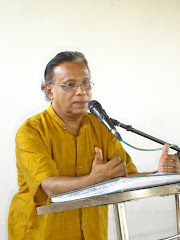
A Discussion with A.S. Balasooriya
Questioner: What is the difference between the consciousness and the mind? Are they same or different?
Balasooriya: These words as popularly used have no distinct definitions. Some use them in the same sense as synonyms, interchangeably. However, here we can attempt at coming to a clear understanding of the two phenomena.
What is mind? Is there such a thing called mind at all? Of course there is thought. You experience it. You experience it arising, running, changing directions, going from one to another. Mind is a projection of thoughts like the apparent circle of fire when you are rotating a glowing stick in a dark night. What you have really is the movement. The quick succession of movements creates the illusion of a circle of fire. Likewise the quick arising and falling of thoughts create the illusion of mind.
Q: You mean : No thought no mind!
B: Right!
Q: Then what is consciousness?
B: Consciousness is also such a projection arising from a group of thoughts.
Q: Explain it.
B:. People speak of consciousness as it is something static, permanent. There is no permanent consciousness. It changes from situation to situation, act to act. For example when you are watching a cinema you are in a different consciousness. Then you are in the consciousness of a spectator. When the show is over you came back to the normal consciousness.
Q: You said early that consciousness arises from a group of thoughts
B: I meant a that consciousness is a product of a particular programme of thoughts. A thought does not arise in isolation. It is a response of mental programme. Take a practical example: What is your response when you hear the word: ‘money’? The responding thought arises from the programme of thoughts, concepts, fears, egoistic motives. You have developed over the past. One thought is connected to a series of thoughts.
Q: Who is the programmer?
B: You are your own programmer! There is no God to decide on your fate. You programme life through your choices of attitudes, values, actions. You choose by your past, cultural, religious and idiosyncratic learning. Isn't a person but a collection of scripts conditioned by the society at large. Is there thinking apart from the stuff stored in the store house of the consciousness?
Q: Yes. Each believer is thinking along the path conditioned by his religion.
B: You see that all organized religions prohibits free thinking. Because such thinking poses a threat to their establishments.
Q: Each religion builds a particular consciousness in its believers.: The Muslim consciousness, Christian consciousness and soon.
B: Consciousness is like a big city with thousands of different stores. In close analysis your consciousness is made of many, many fragmented consciousnesses; small consciousnesses. At a given moment there is the never ending struggle within to surge up one over another. The mind is always in a conflict within itself between different consciousnesses.
Q: You are right when you say that no thought is arise by itself.
B: That is why it is difficult for a person to change, let go the whole of him but even a single thought, attitude or values. All of them are intertwined together as network.. Other supporting thoughts do not allow changing one thought. Here I mean deep changes within, not accommodations, assimilations, shaping and adjustment etc. They are superficial. How much you adjust superficially inwardly you are same. Aren't you?
Q: Can a person change deeply?
B: To explore it we have to find out what is awareness. What is awareness? Again it is a broad concept with a variety of levels of meaning. The consciousness and awareness differ from each other in that the consciousness is a personal construction where as awareness is an intrinsic faculty.
Q: You mean to say that consciousness is constructed while awareness is natural.
B: True. Let’s see go into what is awareness. There is general awareness going all the time. That you have cognition of where you are, what you are doing and with whom you are and so on. With more attention it can be made clearer. This state of cognition can be marred by the thoughts and emotions arising within you.
Q: How the awareness relates to consciousness?
B: The consciousness is like the colour in a glass. On the other hand awareness is spotless. It sees the reality as it is. We were discussing what true change in man is. The true change is awakening from consciousness to awareness. In the light of awareness man changes.